Teaching Philosophy
“Ya’ can’t learn good if you don’t feel good”
I tell this to students at the beginning of every course along with with a listing of my priorities:
1. Your safety
2. Your well-being
3. Your learning
To some, beginning a course this way may seem overly simplistic or trite. However, I have found that it serves the purpose of creating a reciprocal and positive learning environment. It lets students know I am on their side, but also that I need them to help me help them. I emphasize that only after we achieve the first two can we get to the third priority of learning. Student safety, well-being, and learning are not just my responsibility, they are individual students’ responsibility and the responsibility of classmates to each other. I try to be explicit about getting the entire classroom to act as teammates. The core of my teaching philosophy centers around student confidence. Much inspiration is derived from bell hooks’ Teaching to Transgress which points out the role that fear plays in the both students and instructors. The goal is not to be punitive, competitive, or tense, but rather, the goal is to create a learning environment that maximizes how far we can go together. We know from ecological theory that facilitation is a +/+ interaction whereas competition is -/- and I think it is fruitful to apply that lesson to classrooms.
Courses Taught
American River College
NATR 320: Principles of Ecology. Adjunct Professor (Instructor of Record)
I got the opportunity to to design my own ecology course and I focused on going as broad as possible. Especially teaching at a community college, I wanted to introduce students to the wide range of the ecological world so I planned a variety of field trips, readings, and guest speakers. I am particularly proud of bringing in a very diverse set of ecologists - with a focus on ecologists of color - to that class. While I sometimes wonder if I learned more than my students through the experience of designing my own course, I am incredibly proud of the work I did in this class and I know my students benefited from my approach!
UC Davis
WFC 103: Applied Statistics for Wildlife Research. Teaching Assistant
I have come to realize that one my strengths as an instructor is making quantitative or technical concepts feel approachable to students that are typically intimidated by those types of subject. I am just of enough of a ‘math-person’ to understand the world of statistics and translate it for my less math-inclined students. I also do this with my Stats Support Group for graduate students (See: Odds & Ends️ Tab). I have been teaching students R and statistics in this course for a few years now and it is still a thrill when I see a student - who would not have predicted themselves to - fall in love with the subject. It happens a couple of times each year!
WFC 098: Data Literacy for Wildlife Biologists. Teaching Assistant
This course is a bit of a lead-in to the course above but focuses on the fundamentals of the coding language R and general familiarity with understanding graphs and data rather than statistics. Much of what I wrote above applies here, but what I particularly love about this course is the non-traditional grading techniques Dr. Rob Furrow (and I) has implemented! Abandoning the punitive mean percentage score method in favor of re-submissions on assignments until skills are gained not only helps reduce student anxieties but also emphasizes the core goals of the course. I am particularly proud of pushing for individualized ‘code-walkthroughs’ on final projects which serve both to prevent the abuse of AI and helps us shepherd students who need a little extra boost.
PLS 147: California Plant Communities. Teaching Assistant
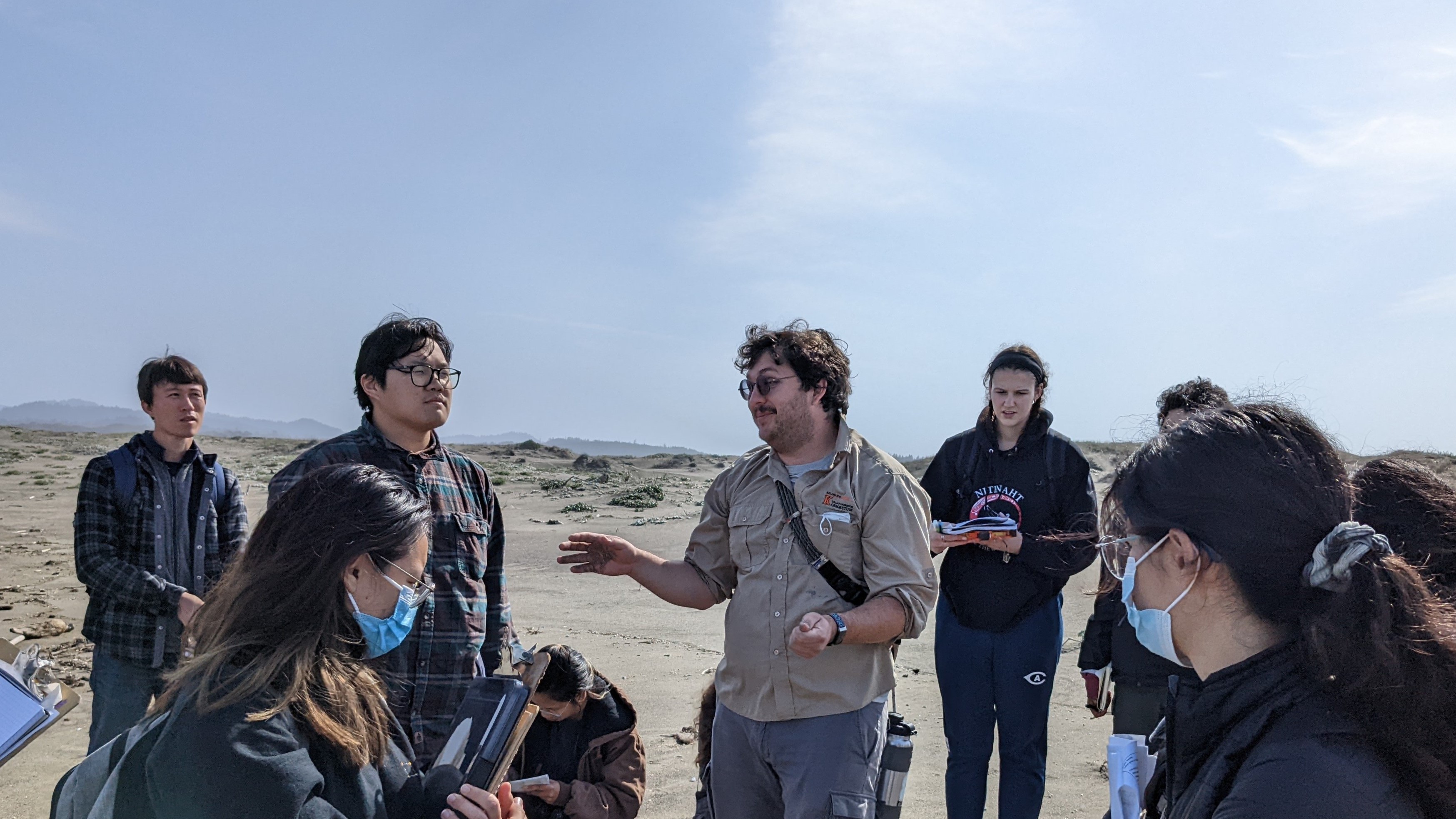
I adored teaching this course because it allowed me to plan field trips all through California’s ludicrously diverse plant communities. As lead-TA, I focused the class on Indigenous land uses, relationships to the ecosystems we visited, and more equitable pedagogical practices. Shifting from overlap with other course, I took the primary evaluative tool from in-the-field memorization quizzes of the Latin names of plants (which were far from ADA compliant) to reflections on what was learned and left to learn from the ecosystems we visited.
SAS 006: Career Discovery Groups. Teaching Assistant
This is a great program that takes students from underrepresented backgrounds and gives the a primer and a mentor (me) as they begin their college experiences. It was such a joy to be so many students’ shepherds into their college lives and some of these mentorships have lasted years. One of my students from this course just recently joined my Dune Crew™️!
ECL 290: Seminar: Ecological Teaching & Mentorship. Instructor
My program allows graduate students to lead their own one unit seminars on topics of their choice. In this case, I chose to strengthen my chops in the pedagogical literature with my peers and it was one of the best learning experiences I’ve had at UC Davis.
ECL 290 Seminar: Functional Ecology. Instructor
In just my second term of UC Davis, I led this seminar on Trait-based ecology.
Purdue University
FNR 21000: Natural Resource Information Management. Teaching Assistant
This course should be called “Map making with ArcGIS”. This is where I first realized my joy in and ability to translate technical concepts to students who are typically intimidated by such subjects. The best compliment I’ve ever received was from another TA who asked how I was able to lead students to discovering the answers to their own questions without just telling them. I did not fully realize I was doing that at the time, but I continually hear from students across courses how helpful that method is!
Kalamazoo College
Maybe it is corny to list the courses I TA-ed for in undergrad, but this is where I first really fell in love with teaching and I am proud of that!
BIOL 224: Ecology & Conservation w/Lab. Undergraduate Teaching Assistant
A classic ecology class with Dr. Binney Girdler!
BIOL 295: Computational Tools for Biologists. Undergraduate Teaching Assistant
This course actually changed the trajectory of my education when I took it. Learning that I had a knack for the technical side of things was a surprised and a pleasure to me and it felt so good to be able to share that feeling!
SEMN 152: First Year Seminar: Roots in the Earth. Undergraduate Teaching Assistant
I loved this course when I took it as a first year and when I TA-ed as a senior. Guiding students into college is such a privilege! All students have to take a writing seminar in their first year but the exact topic is a choice. This one focused on your relationship to nature on a personal and academic level. I actually won a leadership award for my work as a TA in this class!
BIOL 312: Population & Community Ecology W/Lab. Undergraduate Teaching Assistant
I am begging someone to ask my about the “Dead Rat Society” legacy that I left at Kalamazoo College through this class. I promise it’s fun!